
Introduction: The Intersection of Psychology and Predation
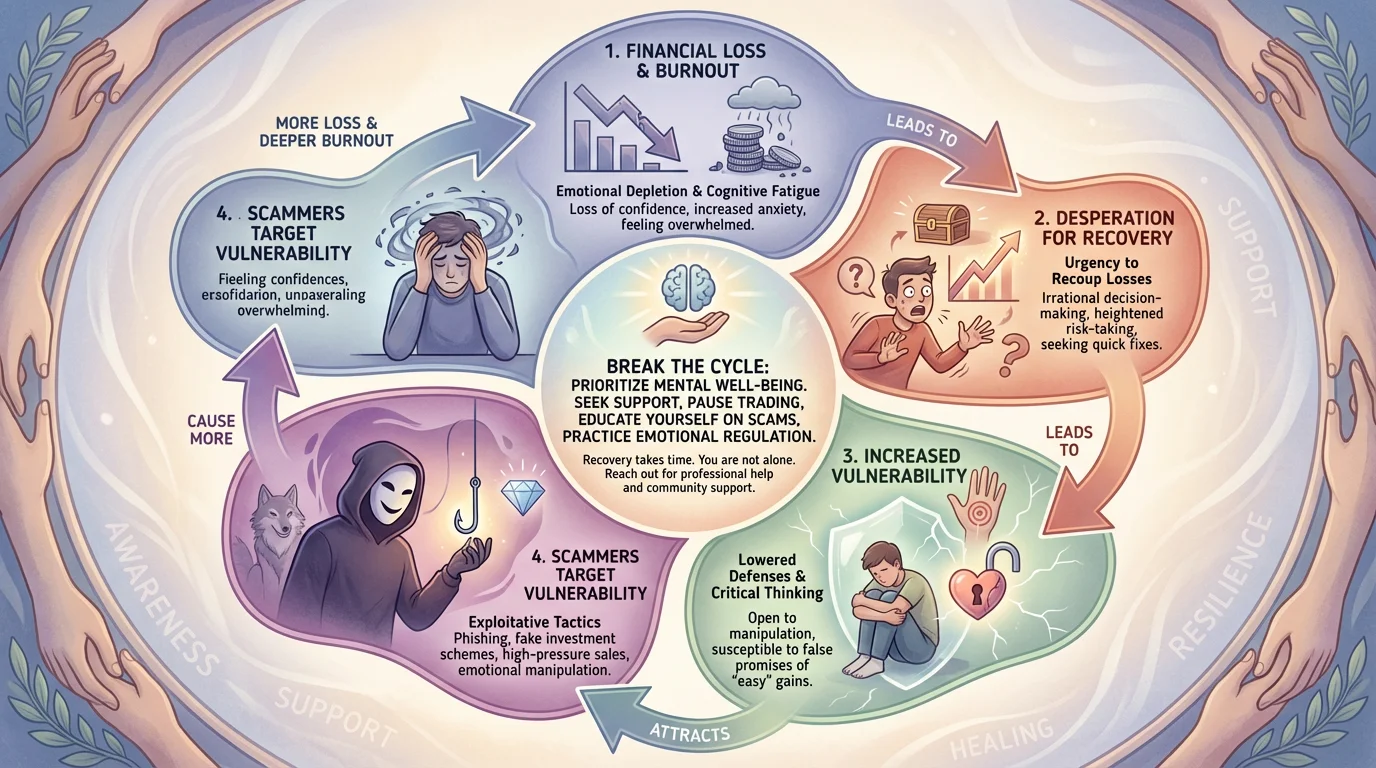
In the world of Forex trading, technical skill and market knowledge are only part of the equation. The other, often underestimated, component is psychological resilience. Trading is an emotionally demanding activity that subjects participants to cycles of hope, fear, elation, and despair. Over time, these emotional swings can lead to a state of burnout—a condition characterized by exhaustion, cynicism, and a diminished sense of personal efficacy.
For most traders, burnout is a signal to step back, reassess, and recover. But for scammers, a burned-out trader is the perfect target. These predators understand that emotional exhaustion creates cognitive vulnerabilities. A trader who is mentally and emotionally depleted is far more likely to make impulsive decisions, ignore red flags, and fall for promises that they would normally dismiss as too good to be true.
This article explores the dangerous intersection of trading psychology and scam tactics. We will examine why emotional burnout makes traders vulnerable, how scammers specifically target this state, and what you can do to protect yourself when you are at your most fragile. This is not just about avoiding scams; it’s about understanding the profound connection between your mental state and your financial security.
—
Understanding Trader Burnout: The Silent Epidemic
Before we can understand why burnout makes traders vulnerable to scams, we must first understand what burnout is and how it manifests in the trading context.
What is Trader Burnout?
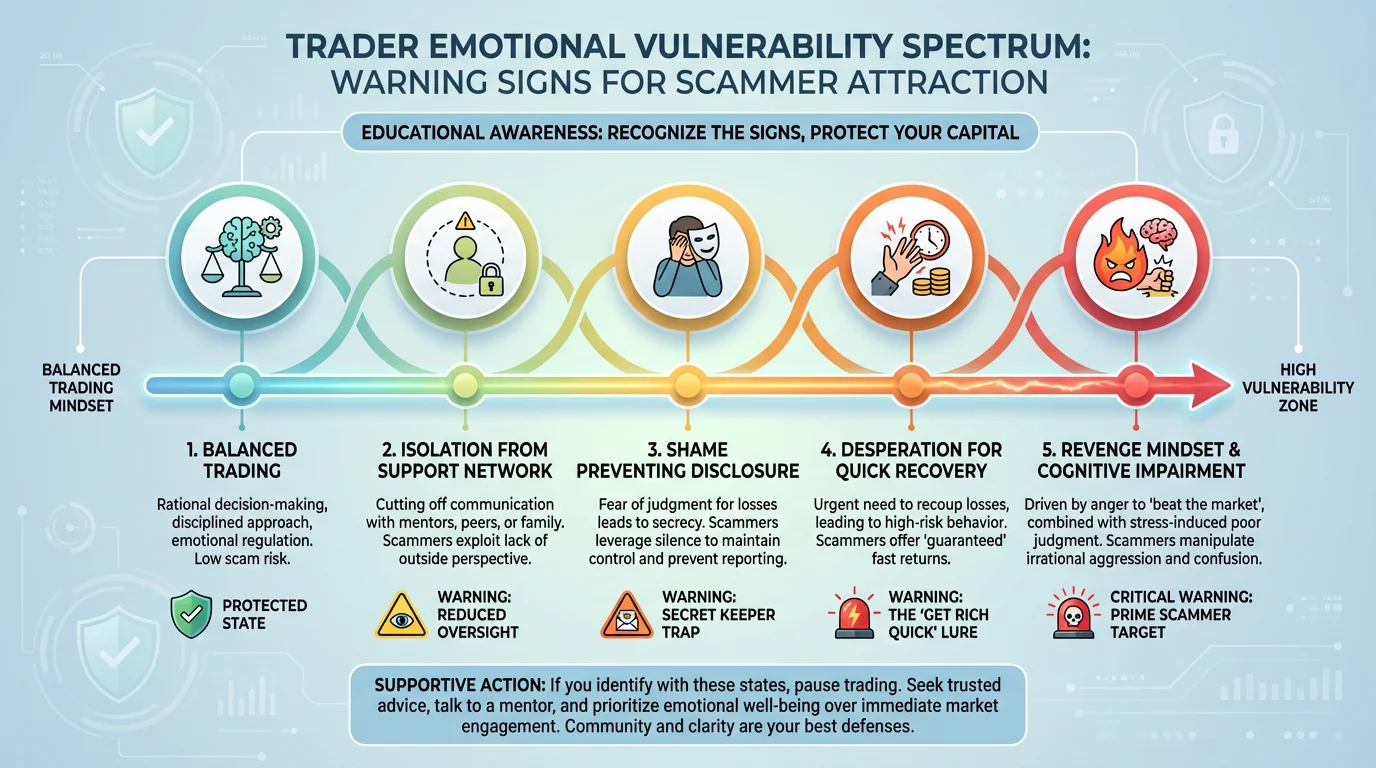
Trader burnout is a state of chronic physical and emotional exhaustion caused by prolonged exposure to the stressors inherent in trading. It is characterized by three core dimensions:
- Emotional Exhaustion: A feeling of being drained, overwhelmed, and unable to cope with the demands of trading.
- Cynicism and Detachment: A loss of enthusiasm for trading, feelings of negativity toward the market, and a sense that effort is futile.
- Reduced Personal Efficacy: A diminished belief in one’s ability to trade successfully, leading to self-doubt and a sense of helplessness.
Common Causes of Trader Burnout
| Cause | Description |
|---|---|
| Prolonged Losing Streaks | Consecutive losses erode confidence and create a sense of hopelessness. |
| Overtrading | Trading too frequently without adequate rest leads to decision fatigue and mental exhaustion. |
| Unrealistic Expectations | Setting unattainable profit goals creates constant disappointment and stress. |
| Lack of Social Support | Trading in isolation without a community or mentor can intensify feelings of loneliness and self-doubt. |
| Financial Pressure | Trading with money one cannot afford to lose creates chronic anxiety and desperation. |
| Information Overload | Constantly consuming market news, analysis, and opinions can lead to analysis paralysis and mental fatigue. |
The Psychological Impact of Burnout
When a trader is burned out, their cognitive and emotional functioning is significantly impaired. Research in psychology has shown that burnout leads to:
-
- Impaired Decision-Making: The prefrontal cortex, responsible for rational thought and impulse control, becomes less active. This makes it harder to evaluate risks and resist temptation.
- Heightened Emotional Reactivity: The amygdala, the brain’s emotional center, becomes hyperactive, leading to stronger feelings of fear, anxiety, and desperation.
- Reduced Skepticism: Exhaustion lowers one’s critical thinking abilities, making it easier to accept information at face value without proper scrutiny.
In this state, a trader is not operating at full capacity. They are vulnerable.
—
How Scammers Identify and Target Burned-Out Traders
Scammers are not random opportunists; they are strategic hunters. They actively seek out traders who are showing signs of emotional distress and burnout. Here’s how they do it.
Tactic #1: Monitoring Online Trading Communities
Scammers infiltrate forums, social media groups, and trading communities. They look for posts that signal emotional distress:
-
- “I’ve lost everything. I don’t know what to do.”
- “I’ve had 10 losing trades in a row. My strategy isn’t working.”
- “I need to make back my losses fast. Any advice?”
These posts are like beacons to a scammer. They indicate a trader who is desperate, discouraged, and potentially willing to take risks they wouldn’t normally consider.
Photo Example: A Vulnerable Post
[Image: A screenshot of a forum post where a trader expresses desperation after a series of losses. An arrow points to a reply from a “helpful” user offering a “guaranteed recovery system.”]
Tactic #2: The “Empathy First” Approach
Once a target is identified, the scammer does not immediately pitch their scam. Instead, they lead with empathy. They reply to the distressed post with messages like:
-
- “I’ve been exactly where you are. I know how it feels.”
- “Don’t give up. I was in the same situation last year, and I found a way out.”
- “You’re not alone. Let me share what worked for me.”
This creates an emotional bond. The trader feels understood and supported. The scammer is no longer a stranger; they are a fellow trader who has walked the same painful path. This is the foundation of trust that will later be exploited.
Tactic #3: Offering a “Solution” Tailored to the Emotional State
The scammer’s offer is not framed as a get-rich-quick scheme (which a burned-out trader might still be skeptical of). Instead, it is framed as a recovery tool, a way to regain control, or a “safe” method to get back on track.
-
- For the Desperate Trader: “This system helped me recover $10,000 in losses in just two months.”
- For the Discouraged Trader: “You don’t need a complicated strategy. This EA does all the work for you.”
- For the Isolated Trader: “Join our private group. We support each other and share winning signals.”
The offer is designed to address the specific emotional need of the target. It’s not about greed; it’s about hope, belonging, and the restoration of self-efficacy.
—
The Psychological Vulnerabilities Exploited by Scammers
Scammers targeting burned-out traders exploit specific cognitive and emotional vulnerabilities that are amplified by exhaustion and distress.
Vulnerability #1: The Desperation Bias
When a trader is in a state of desperation—having lost significant capital and feeling that they are running out of options—their risk assessment becomes distorted. They are more willing to take high-risk actions because the perceived cost of inaction (continued loss, failure) feels greater than the risk of the action itself (trying a new, unverified system).
How Scammers Exploit It:
They frame their offer as the “last chance” or the “only way out.” They create a sense of urgency, knowing that a desperate trader is more likely to act impulsively.
Vulnerability #2: The Sunk Cost Fallacy (Amplified)
The sunk cost fallacy is the tendency to continue investing in a losing venture because of the resources already committed. For a burned-out trader who has already lost a significant amount, this bias is particularly strong. They feel they must keep trying to recover the losses, even if it means taking on more risk.
How Scammers Exploit It:
They position their offer as a way to “make it all back.” They understand that the trader is not thinking rationally about future expected value; they are emotionally fixated on recovering past losses.
Vulnerability #3: Lowered Cognitive Defenses
Mental exhaustion impairs critical thinking. A burned-out trader is less likely to:
-
- Conduct thorough due diligence.
- Question the legitimacy of testimonials.
- Verify regulatory claims.
- Recognize classic red flags.
How Scammers Exploit It:
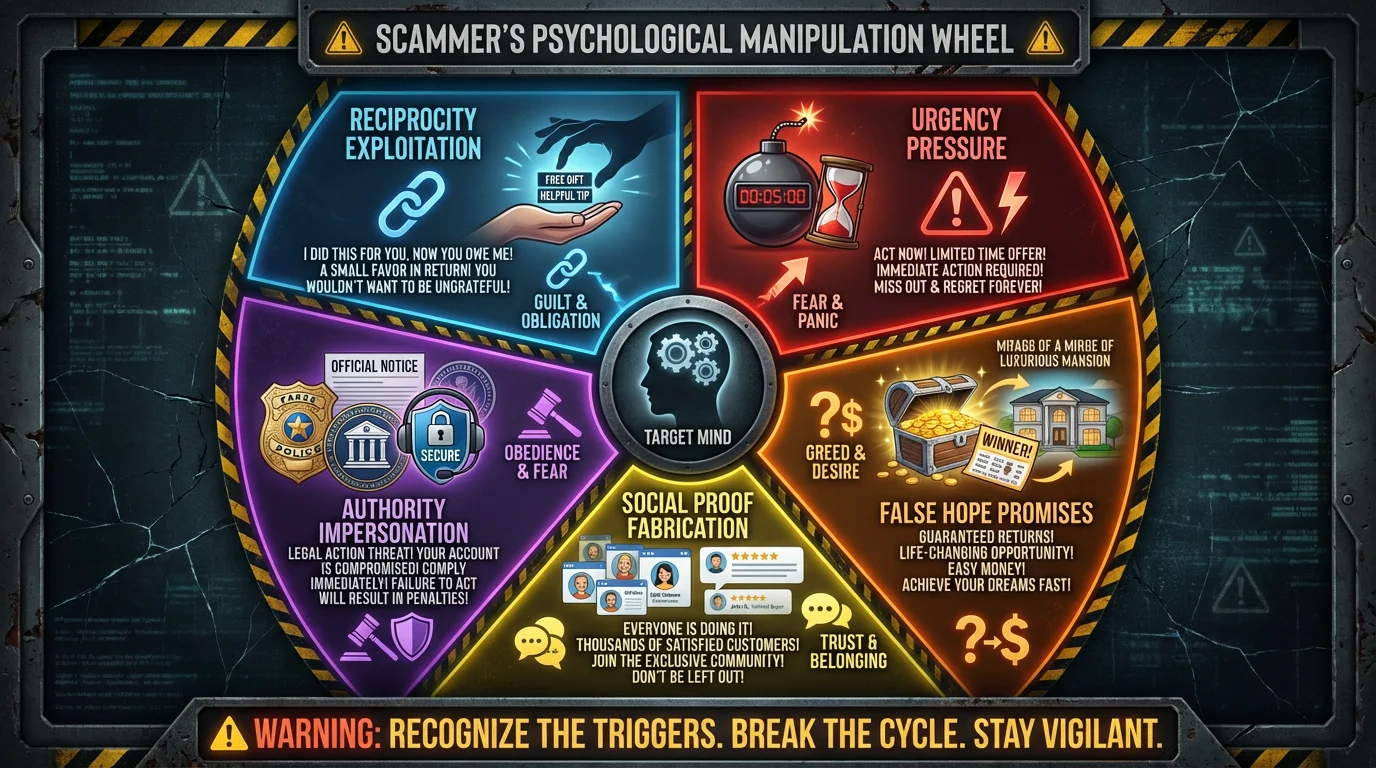
They present information in a way that requires minimal cognitive effort to accept. They use social proof (fake testimonials), authority bias (fake credentials), and emotional appeals rather than logical arguments. The burned-out trader, lacking the mental energy to scrutinize, accepts the information at face value.
Vulnerability #4: The Need for External Validation
Burnout often leads to a crisis of confidence. The trader no longer trusts their own judgment. They are looking for an external authority or system to tell them what to do.
How Scammers Exploit It:
They position themselves as the expert, the mentor, or the provider of a “proven system.” They offer the burned-out trader what they crave: certainty and guidance. The trader, desperate to believe in something, transfers their trust to the scammer.
—
Case Study: The “Recovery Mentor” Scam
To illustrate these dynamics, let’s examine a real-world case (details anonymized).
The Victim: Michael
Michael was a 35-year-old trader who had been actively trading Forex for three years. After a particularly brutal six-month losing streak, he had lost $18,000—a significant portion of his savings. He was emotionally exhausted, questioning his abilities, and feeling isolated. He posted about his struggles in an online trading forum.
The Scammer: “TraderMentor_Alex”
Within hours of Michael’s post, he received a private message from a user named “TraderMentor_Alex.” Alex’s message was empathetic: “I read your post, and I felt like I was reading my own story from two years ago. I lost $20,000 and was ready to quit. But I found a mentor who changed everything for me. If you’re open to it, I’d love to share what I learned.”
Michael, feeling understood and desperate for guidance, responded. Over the next week, Alex built a relationship with Michael, sharing his own (fabricated) story of loss and recovery. He then introduced Michael to his “mentor,” who offered a “personalized trading course” and access to a “private signal group” for a one-time fee of $3,000.
The Exploitation
Michael was in a perfect storm of vulnerability:
-
- Desperation: He needed to recover his losses.
- Exhaustion: He didn’t have the mental energy to conduct thorough due diligence.
- Isolation: He felt alone and craved the community and support Alex was offering.
- Sunk Cost: He felt he had already lost so much that he had to try “one more thing.”
Michael paid the $3,000. The “course” was generic, plagiarized content. The “signals” were random and led to further losses. When Michael tried to get a refund, Alex and the “mentor” disappeared. Michael had been scammed, losing an additional $3,000 at a time when he could least afford it.
—
Protecting Yourself When You’re Burned Out
If you recognize yourself in this article—if you are feeling exhausted, discouraged, or desperate—you are at heightened risk. Here is your protection plan.
Step 1: Recognize the State You’re In
Self-awareness is your first line of defense. If you are experiencing:
-
- Chronic stress or anxiety about trading.
- A sense of hopelessness or futility.
- Impulsive urges to “try something new” to recover losses.
- Difficulty sleeping or concentrating.
…then you are likely in a state of burnout. Acknowledge this. It is not a sign of weakness; it is a signal that you need to change your approach.
Step 2: Implement a Trading Pause
When you are burned out, the worst thing you can do is continue trading or make major financial decisions. Implement a mandatory pause:
-
- Duration: At least two weeks, ideally one month.
- Purpose: To allow your nervous system to recover and your cognitive functions to return to baseline.
- Activities: Engage in non-trading activities that bring you joy and relaxation. Exercise, spend time with loved ones, pursue hobbies.
Step 3: Establish a “No New Commitments” Rule
While you are in a state of burnout, make a firm rule: No new financial commitments related to trading. This means:
-
- No purchasing new courses, EAs, or signal services.
- No opening accounts with new brokers.
- No investing in “recovery” opportunities.
This rule protects you from making decisions you will regret when you are not in a clear state of mind.
Step 4: Seek Support from Trusted Sources
Do not isolate yourself. Reach out to:
-
- A trusted friend or family member who can provide emotional support.
- A therapist or counselor who specializes in stress management or financial trauma.
A reputable trading mentor or community (one you have thoroughly vetted before* your burnout).
Avoid seeking support from strangers in online forums who offer unsolicited advice or “solutions.”
Step 5: Rebuild Gradually
When you are ready to return to trading, do so gradually:
- Start with a demo account to rebuild confidence without financial risk.
- Trade with the smallest position sizes possible.
- Focus on process and discipline, not on recovering losses.
—
Conclusion: Your Mental State is Your First Line of Defense
The relationship between trading psychology and scam vulnerability is profound. Scammers do not just target ignorance; they target emotional states. They are experts at identifying and exploiting the psychological wounds created by burnout, loss, and desperation.
Your best defense is not just knowledge of scam tactics, but self-awareness of your own mental and emotional state. When you are burned out, you are not operating at full capacity. You are vulnerable. Recognizing this and taking proactive steps to protect yourself—through rest, support, and firm boundaries—is not just about avoiding scams. It’s about preserving your financial future and your mental health.
If you are currently in a state of burnout, please take this message seriously: Step back. Rest. Recover. The market will still be there when you return. But if you allow a scammer to exploit your vulnerability, the damage may be irreversible.
—
Frequently Asked Questions (FAQ)
Q1: How can I tell if I’m burned out or just having a bad trading week?
A1: A bad week is temporary and usually tied to specific market conditions. Burnout is chronic and pervasive. If you’ve been feeling exhausted, hopeless, and detached from trading for several weeks or months, and if these feelings are affecting your sleep, mood, and decision-making, you are likely experiencing burnout.
Q2: Is it normal to feel desperate after a series of losses?
A2: It is normal to feel disappointed and frustrated. However, if the feeling escalates to desperation—a sense that you must recover the losses immediately, no matter the risk—this is a warning sign. Desperation impairs judgment and makes you vulnerable to scams. This is the time to step back, not to double down.
Q3: Can talking to other traders online help with burnout?
A3: It can, but be very selective. Reputable trading communities that focus on education, strategy discussion, and mutual support can be helpful. However, avoid forums where the focus is on sharing “hot tips,” promoting services, or where members are overly negative or desperate. These environments can amplify stress and make you more vulnerable to scammers.
Q4: What if I can’t afford to take a break from trading because I need the income?
A4: If you are trading with money you cannot afford to lose, or if you are relying on trading as your primary income source while you are not consistently profitable, you are in a very high-risk situation. This is a form of financial pressure that significantly increases burnout and scam vulnerability. You may need to seek financial counseling or explore alternative income sources while you recover and rebuild your trading skills in a lower-pressure environment.