
Introduction: When Your Brain Becomes Your Worst Enemy
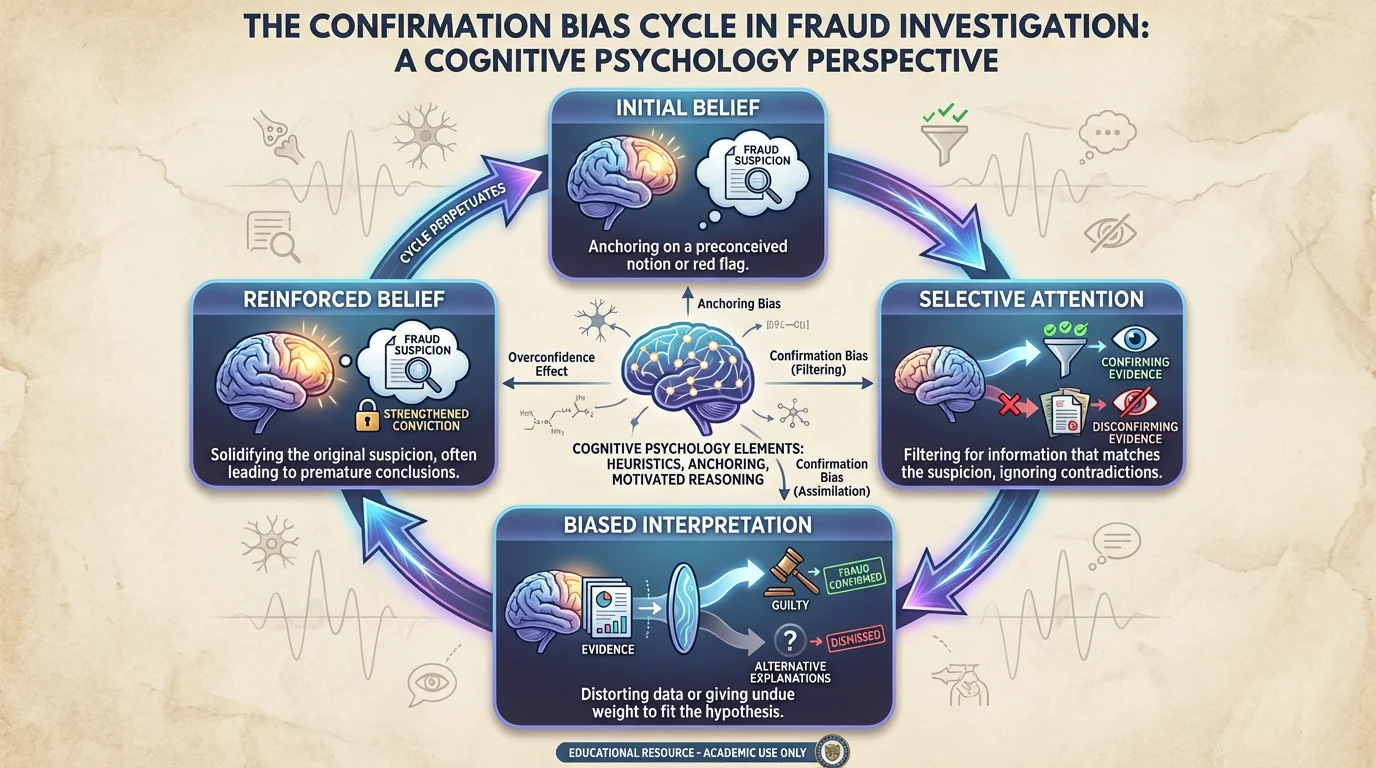
Human beings are not rational calculators. Despite our best intentions, our brains are wired with cognitive shortcuts—biases—that helped our ancestors survive but can lead us astray in the complex, information-rich environment of modern financial markets. Among these biases, confirmation bias stands out as one of the most powerful and dangerous, particularly in the context of Forex trading and scam vulnerability.
Confirmation bias is the tendency to search for, interpret, favor, and recall information in a way that confirms one’s preexisting beliefs or hypotheses. In trading, this means that once you form an opinion about a market direction, a strategy, or an investment opportunity, your brain will actively work to find evidence that supports that opinion while ignoring or dismissing contradictory information.
This cognitive quirk doesn’t just lead to bad trades; it creates a psychological environment where scams can flourish. When a scammer presents you with an opportunity that aligns with what you want to believe—that easy profits are possible, that you can recover your losses, that this system is different—your confirmation bias kicks in. You become an active participant in your own deception, seeking out the “proof” that the scam is legitimate while your brain filters out the glaring red flags.
This article explores the intricate relationship between confirmation bias, risk perception, and fraud belief. We will examine how this bias operates in the trading context, how scammers weaponize it, and how you can train yourself to recognize and counteract it. Understanding confirmation bias is not just about becoming a better trader; it’s about building a mental defense system that protects you from the most sophisticated forms of financial fraud.
—
H2: Understanding Confirmation Bias: The Science
Before we can combat confirmation bias, we must understand how it works at a neurological and psychological level.
H3: The Evolutionary Origins

Confirmation bias is not a flaw; it’s a feature. From an evolutionary perspective, it served an important function. Our ancestors lived in a world where quick decisions were often a matter of life and death. If you believed that rustling in the bushes was a predator, it was safer to act on that belief (and run) than to waste time gathering more evidence. Those who hesitated to confirm their suspicions were less likely to survive.
In the modern world, however, this bias can be maladaptive. We are no longer making split-second survival decisions. We are making complex financial choices that require careful analysis of evidence. But our brains are still running on the same ancient software.
H3: How Confirmation Bias Operates
Confirmation bias manifests in four key ways:
- Biased Search: When you have a hypothesis, you actively seek out information that supports it. If you believe a broker is legitimate, you will search for positive reviews and testimonials.
- Biased Interpretation: When you encounter ambiguous information, you interpret it in a way that confirms your belief. A vague regulatory claim is seen as “good enough” if you want to believe the broker is safe.
- Biased Memory: You remember information that confirmed your belief more readily than information that contradicted it. You recall the one positive review but forget the three negative ones.
- Biased Attention: You pay more attention to confirming evidence and less attention to disconfirming evidence. The red flags are there, but your brain doesn’t register them as important.
H3: Confirmation Bias in the Brain
Neuroscience research has shown that confirmation bias is linked to activity in the brain’s reward system. When you encounter information that confirms your belief, your brain releases dopamine, a neurotransmitter associated with pleasure and reward. This creates a positive feedback loop: seeking confirming information feels good, so you do more of it.
Conversely, encountering information that contradicts your belief activates areas of the brain associated with negative emotions and cognitive dissonance. Your brain experiences this as uncomfortable, so it avoids or dismisses such information.
—
H2: Confirmation Bias in Forex Trading: A Perfect Storm
The Forex market is an ideal environment for confirmation bias to run wild. Here’s why.
H3: The Ambiguity of Market Data
The Forex market is incredibly complex, with thousands of variables influencing price movements at any given time. This ambiguity means that almost any market outcome can be interpreted in multiple ways. A trader with a bullish bias will find reasons why a price drop is just a “temporary pullback.” A trader with a bearish bias will see the same drop as confirmation of an impending crash.
H3: The Abundance of Information
The internet provides an endless stream of market analysis, news, and opinions. This abundance makes it easy to find information that supports any viewpoint. If you want to believe that EUR/USD is going up, you can find ten analysts who agree. If you want to believe it’s going down, you can find ten who agree with that too.
H3: The Emotional Investment
Trading is not a dispassionate activity. When you enter a trade, you have a financial and emotional stake in being right. This emotional investment amplifies confirmation bias. You don’t just want to find evidence that your trade is correct; you need to find it to avoid the psychological pain of admitting you were wrong.
—
H2: How Scammers Weaponize Confirmation Bias
Scammers are not just aware of confirmation bias; they are experts at exploiting it. Here’s how they do it.
H3: Tactic #1: Planting the Seed of Belief
The first step in a scam is to get you to form a positive initial belief. This is done through:
-
- Appealing Narratives: “This EA uses AI to predict market movements with 95% accuracy.”
- Social Proof: Fake testimonials and reviews that create the impression of widespread success.
- Authority Signals: Professional-looking websites, fake credentials, and sophisticated jargon.
Once you form the initial belief that “this might be legitimate,” your confirmation bias takes over. You start looking for evidence that supports this belief.
H3: Tactic #2: Providing Confirming “Evidence”
The scammer then provides you with a steady stream of information designed to confirm your initial belief:
-
- Cherry-Picked Results: They show you only the winning trades, never the losses.
- Fabricated Backtests: They present you with a perfect equity curve.
- Fake Myfxbook Accounts: They link to accounts showing impressive profits.
Your confirmation bias leads you to focus on this evidence and to interpret it as proof of legitimacy. You are less likely to question the source or seek independent verification.
H3: Tactic #3: Dismissing Red Flags as “Misunderstandings”
When you do encounter a red flag—perhaps a negative review or a lack of verifiable regulation—the scammer has a prepared response:
-
- “That review is from a competitor trying to sabotage us.”
- “We are in the process of getting regulated by the FCA.”
- “Our system is so advanced that most people don’t understand it.”
Because you want to believe, your confirmation bias leads you to accept these explanations. You rationalize the red flags away rather than treating them as serious warnings.
H3: Tactic #4: Creating an Echo Chamber
Scammers often create private groups (e.g., Telegram channels, Facebook groups) where only positive information is shared. Negative comments are deleted, and skeptical members are banned. This creates an echo chamber where your confirmation bias is constantly reinforced by the apparent consensus of the group.
—
H2: The Risk Illusion: When Confirmation Bias Distorts Probability
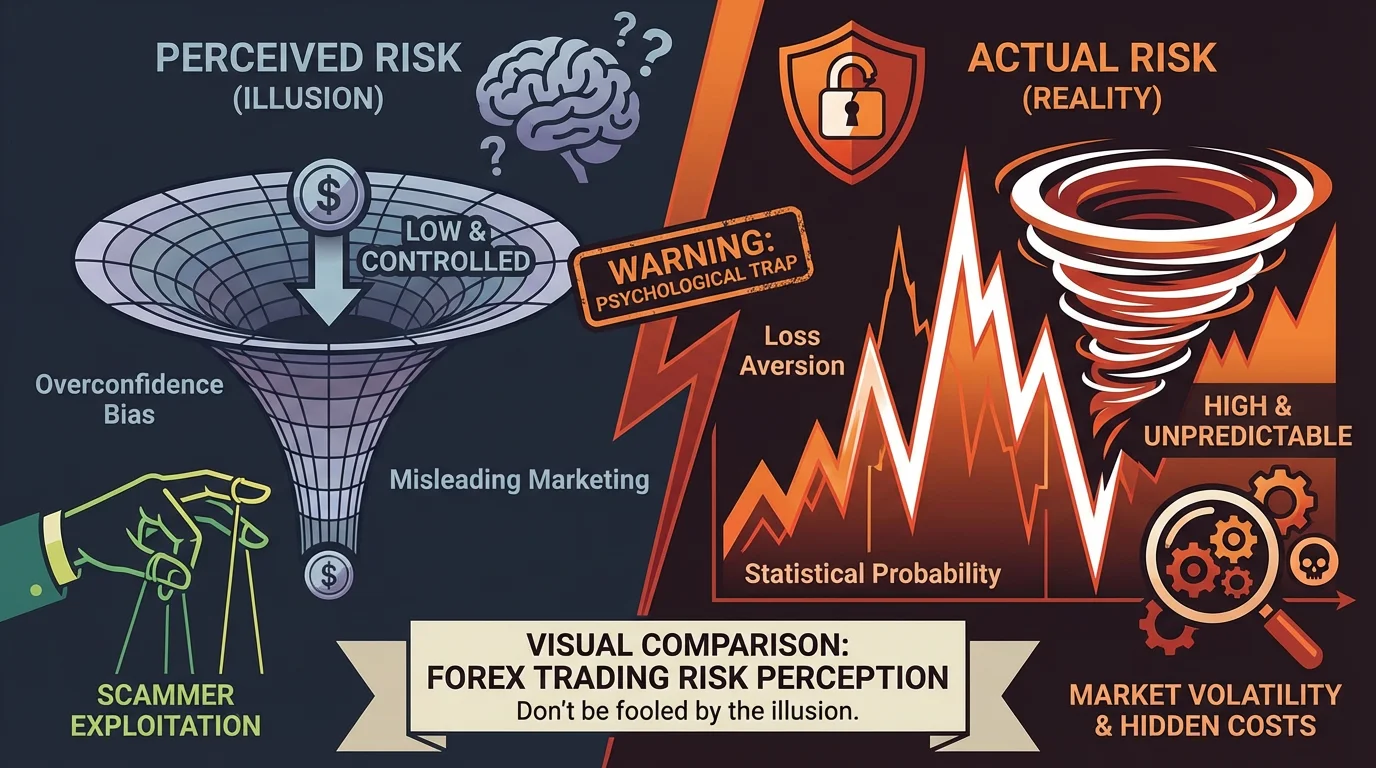
One of the most dangerous effects of confirmation bias in the context of scams is the creation of a “risk illusion.” This is the phenomenon where your biased perception of the evidence leads you to dramatically underestimate the actual risk of an investment.
H3: The Mechanism
-
- Initial Belief: You encounter a scam opportunity and form the belief that it might be legitimate.
- Biased Evidence Gathering: You seek out and focus on confirming evidence (positive reviews, impressive results).
- Distorted Risk Assessment: Because you have found so much “evidence” that the opportunity is legitimate, you conclude that the risk is low.
- Overconfident Decision: You invest a significant amount of money, believing you have done your due diligence.
The reality is that the risk was always high. The “evidence” you gathered was either fabricated or misinterpreted. But your confirmation bias created an illusion of safety.
H3: Case Study: The “Verified” Scam Broker
Consider the case of a trader named Alex (name changed). Alex was researching a new broker called “GlobalTradeFX.” He wanted to believe it was legitimate because they offered a generous welcome bonus.
-
- Biased Search: Alex searched for “GlobalTradeFX reviews” and found several positive reviews on the first page of Google (which were fake, paid reviews).
- Biased Interpretation: The broker’s website claimed to be “regulated by the IFSC” (a weak offshore regulator). Alex interpreted this as “regulated,” not recognizing that it was not a top-tier authority.
- Biased Attention: Alex saw a Myfxbook account linked on the site showing good performance. He did not notice that the account was labeled “Demo,” not “Live.”
- Dismissing Red Flags: When Alex found one negative review, he dismissed it as a “disgruntled customer” because the broker had provided a response claiming the customer had violated terms of service.
Alex concluded that GlobalTradeFX was a low-risk opportunity. He deposited $5,000. Within a month, when he tried to withdraw his profits, the broker blocked his account. It was a scam. Alex’s confirmation bias had created a risk illusion that cost him $5,000.
—
H2: Breaking Free: Strategies to Counter Confirmation Bias
Confirmation bias is a powerful force, but it is not insurmountable. Here are evidence-based strategies to counteract it.
H3: Strategy #1: Actively Seek Disconfirming Evidence
This is the most powerful antidote to confirmation bias. Instead of searching for reasons why an opportunity is good, force yourself to search for reasons why it might be a scam.
-
- Search Query Shift: Instead of “Broker X reviews,” search for “Broker X scam” or “Broker X withdrawal problems.”
- Devil’s Advocate: Before making a decision, write down all the reasons why the opportunity might be fraudulent. Force yourself to take the opposite position.
H3: Strategy #2: Implement a “Pre-Mortem” Analysis
A pre-mortem is a mental exercise where you imagine that your decision has failed spectacularly, and you work backward to identify what went wrong.
-
- The Exercise: “It is six months from now. I invested in this opportunity, and I lost all my money. What were the warning signs I missed?”
This exercise forces you to consider negative outcomes and identify red flags you might be ignoring due to confirmation bias.
H3: Strategy #3: Use a Checklist
Checklists are powerful tools for reducing cognitive bias. They force you to systematically evaluate all relevant factors, not just the ones your bias wants you to focus on.
-
- Example Checklist for Evaluating a Broker:
* [ ] Is the broker regulated by a top-tier authority (FCA, ASIC, CySEC, CFTC)?
* [ ] Have I independently verified their regulation on the official regulator’s website?
* [ ] Have I searched for negative reviews and complaints?
* [ ] Have I tested the withdrawal process with a small amount?
* [ ] Are there any red flags (offshore location, vague claims, high-pressure tactics)?
If you cannot check all the boxes, do not proceed.
H3: Strategy #4: Introduce a “Cooling-Off” Period
Confirmation bias is strongest when you are emotionally invested and under time pressure. A cooling-off period breaks this cycle.
-
- The Rule: Before making any significant financial decision related to trading (opening an account, buying an EA, subscribing to a service), wait 48 hours. Use this time to conduct your disconfirming evidence search and pre-mortem analysis.
H3: Strategy #5: Seek an Independent, Skeptical Opinion
Share your opportunity with a trusted friend, family member, or mentor who has no emotional investment in the outcome. Ask them to play devil’s advocate and point out potential problems.
- The Key: This person must be genuinely skeptical and willing to challenge you. If you only seek opinions from people who will agree with you, you are just reinforcing your confirmation bias.
—
H2: Conclusion: The Mind is the Battlefield
In the fight against Forex scams, the primary battlefield is not the market, the internet, or even the scammer’s website. It is your own mind. Confirmation bias is one of the scammer’s most powerful allies because it turns you into an unwitting accomplice in your own deception.
But awareness is power. By understanding how confirmation bias operates, recognizing when it is influencing your decisions, and implementing systematic strategies to counteract it, you can reclaim control. You can shift from being a passive victim of your own cognitive architecture to being an active, critical thinker who makes decisions based on evidence, not wishful thinking.
The risk illusion is just that—an illusion. The red flags are real. The scams are real. And your ability to see them clearly, despite your brain’s biases, is the most valuable skill you can develop as a trader.
—
Frequently Asked Questions (FAQ)
Q1: If confirmation bias is so powerful, how can I ever trust my own judgment?
A1: You can trust your judgment when you have implemented systematic processes to counteract bias. This means using checklists, actively seeking disconfirming evidence, and introducing cooling-off periods. Trust is earned through process, not through feeling confident.
Q2: Isn’t it exhausting to constantly question everything?
A2: Healthy skepticism does not mean paranoia. It means having a systematic verification process for significant decisions. Once you have verified something through a rigorous process, you can trust it. The exhaustion comes from making impulsive decisions based on emotion and then dealing with the consequences.
Q3: Can confirmation bias ever be useful in trading?
A3: In very limited contexts, yes. Once you have developed a well-tested trading strategy, a degree of confidence (which involves some confirmation bias) can help you stick to your plan during periods of drawdown. However, this is only beneficial after the strategy has been rigorously tested and verified. Confirmation bias is dangerous during the evaluation and decision-making phase.
Q4: How do I know if I’m experiencing confirmation bias or if I’m just being appropriately confident?
A4: Ask yourself: “Have I actively searched for reasons why this might be wrong?” If the answer is no, you are likely experiencing confirmation bias. Appropriate confidence comes from having considered and addressed counterarguments, not from having ignored them.