
How to Use a Trading Journal to Rewire Your Decision-Making
In the quest for trading mastery, traders often focus on finding the perfect strategy, the most accurate indicator, or the most sophisticated algorithm. While these are all important components of a successful trading approach, they are not the most critical. The single most powerful tool for improving your trading performance is not something you can buy or download; it is something you create yourself: a trading journal. A well-kept trading journal is more than just a record of your trades; it is a powerful tool for self-discovery, a mirror that reflects your decision-making processes, and a roadmap for continuous improvement. This article will explore how to use a forex trading journal template to rewire your brain, identify your patterns, and transform your trading from a game of chance into a business of skill.
What is a Trading Journal? Understanding Its True Power
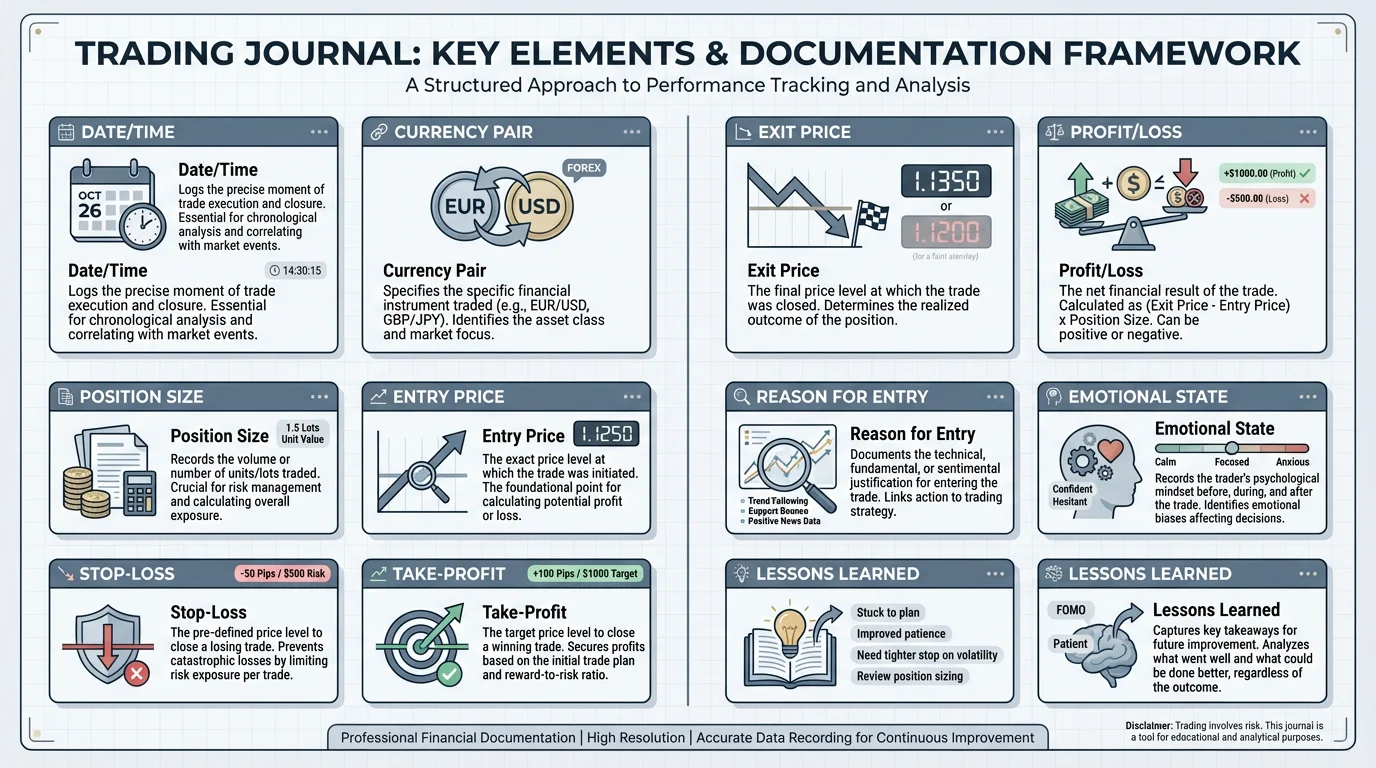
A trading journal is a detailed record of your trading activity. It is a place where you document not only the technical aspects of your trades (e.g., entry price, exit price, stop-loss), but also the psychological and emotional aspects (e.g., your reasons for entering the trade, your emotional state, your thought process). A trading journal can be as simple as a notebook and a pen, or it can be as sophisticated as a dedicated software program. The format is less important than the content and the consistency with which you use it.
The key insight is that a trading journal is not just about record-keeping; it’s about creating a feedback loop that allows you to learn from your experiences. Every trade is a learning opportunity, and your trading journal is the mechanism by which you extract that learning.
Think of your trading journal as your personal trading laboratory. Just as a scientist conducts experiments, records the results, and analyzes the data to draw conclusions, you are conducting trading experiments and using your journal to analyze the results. The difference is that your experiments involve real money, so the stakes are high and the learning is deep.
Why is a Trading Journal So Important? The Science of Learning
A trading journal is the ultimate tool for self-awareness and performance improvement. It allows you to:
Identify Your Strengths and Weaknesses
By reviewing your past trades, you can identify the strategies, market conditions, and timeframes where you perform best, and the areas where you need to improve. You might discover that you’re profitable when trading during the London session but lose money during the Asian session. Or you might discover that you’re good at trading breakouts but terrible at trading reversals.
This self-knowledge is invaluable. Once you know your strengths, you can focus on trading in those areas. Once you know your weaknesses, you can either work to improve them or avoid them altogether.
Track Your Progress
A trading journal provides an objective record of your performance over time. This can help you to stay motivated and to see how far you have come. Many traders are surprised to discover that they’ve made significant progress when they review their journals. They might see that their win rate has improved, or that their average winning trade has increased.
Progress tracking is also important for motivation. Trading can be a long and difficult journey, and it’s easy to get discouraged. By tracking your progress, you can see that you’re moving in the right direction, even if progress is slow.
Learn from Your Mistakes
Every trader makes mistakes. A trading journal allows you to analyze your mistakes in a calm and objective manner, so that you can learn from them and avoid repeating them in the future. This is one of the most powerful benefits of keeping a journal.
When you make a mistake in trading, your natural instinct might be to beat yourself up or to try to forget about it. But this is exactly the wrong approach. Instead, you should analyze the mistake carefully. What went wrong? Why did it go wrong? What could you have done differently? By analyzing your mistakes systematically, you can turn them into valuable learning experiences.
Improve Your Discipline
The act of keeping a trading journal forces you to be more mindful and deliberate in your trading. It can help you to stick to your trading plan and to avoid making impulsive decisions. There’s something about knowing that you’re going to have to write down your trades that makes you more careful about which trades you take.
Develop a Winning Mindset
By focusing on the process of continuous improvement, a trading journal can help you to develop the confidence and resilience needed for long-term success. As you see yourself improving over time, your confidence grows. As you learn from your mistakes, your resilience increases. These psychological shifts are just as important as the technical improvements you make to your trading.
Key Elements of a Comprehensive Trading Journal
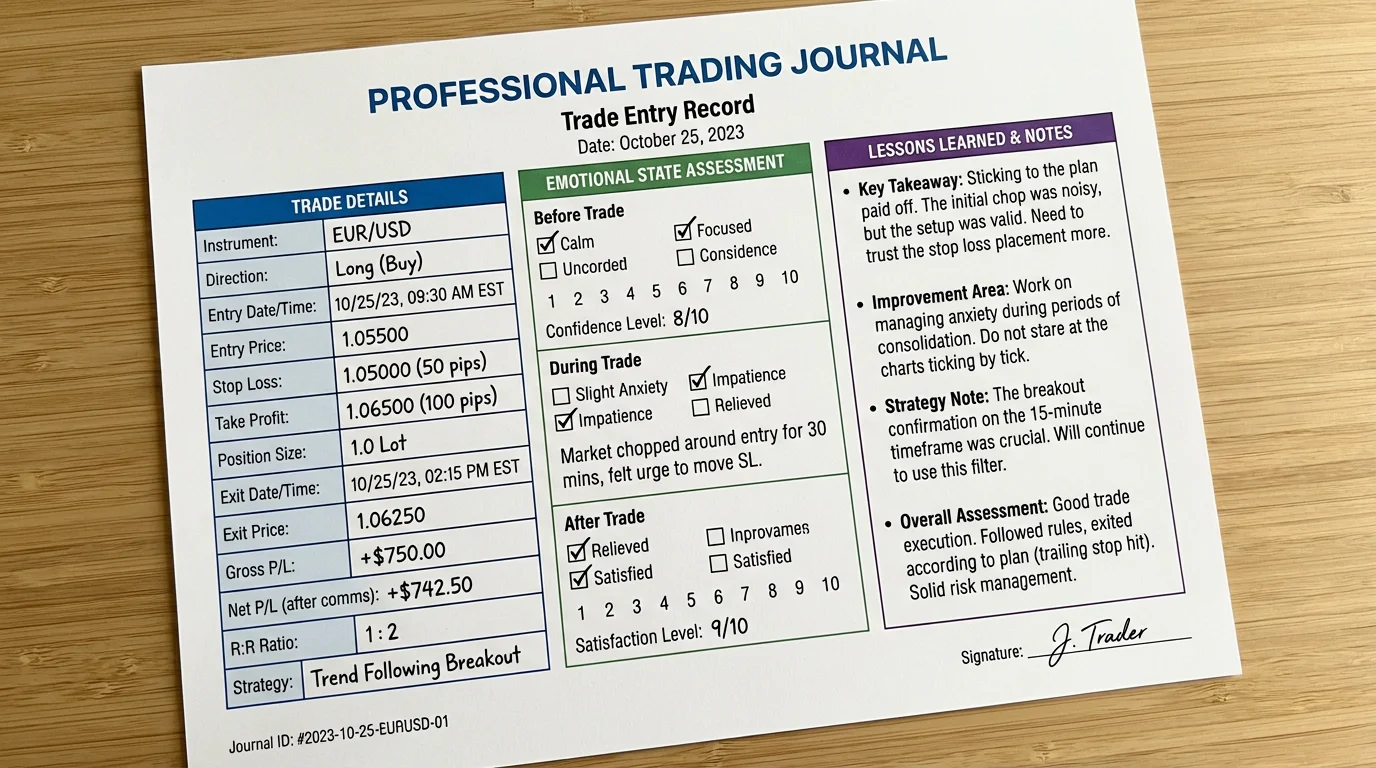
A comprehensive trading journal should include the following key elements:
Trade Details
– Date and Time: The date and time of the trade.
– Currency Pair: The currency pair you are trading.
– Direction: Whether you went long or short.
– Position Size: The size of your position (in lots or units).
– Entry Price: The price at which you entered the trade.
– Stop-Loss: The price at which you will exit the trade if it moves against you.
– Take-Profit: The price at which you will exit the trade if it moves in your favor.
– Exit Price: The price at which you actually exited the trade.
– Profit/Loss: The profit or loss on the trade (in pips and in currency).
Analysis and Reasoning
– Reason for Entry: A detailed explanation of why you entered the trade. This should include your analysis of the market, the specific setup you were trading, and any other factors that influenced your decision.
– Strategy Used: Which trading strategy or setup did you use for this trade?
– Timeframe: What timeframe were you trading on?
– Support and Resistance: What were the key support and resistance levels?
– Risk-Reward Ratio: What was your planned risk-reward ratio for this trade?
Emotional and Psychological Assessment
– Emotional State Before Trade: What was your emotional state before entering the trade? Were you feeling confident, anxious, or something else?
– Emotional State During Trade: How did you feel while the trade was open? Did your emotions change as the trade progressed?
– Emotional State After Trade: How did you feel after the trade closed? Did you feel satisfied, frustrated, or something else?
– Confidence Level: On a scale of 1-10, how confident were you in this trade?
– Adherence to Plan: Did you follow your trading plan for this trade, or did you deviate from it?
Lessons and Reflections
– What Went Well: What did you do well in this trade? What can you learn from this success?
– What Could Be Improved: What could you have done better? What mistakes did you make?
– Lessons Learned: What is the key takeaway from this trade? What will you do differently next time?
– Overall Assessment: On a scale of 1-10, how would you rate your execution of this trade?
Free Downloadable Trading Journal Template
To help you get started, we have created a free downloadable forex trading journal template in both Excel and PDF format. This template includes all of the key elements listed above, as well as some additional features to help you analyze your performance. The template is designed to be easy to use, but comprehensive enough to capture all the important information about your trades.
📊 Excel Template
Professional spreadsheet with automatic calculations for P&L, win rate, and profit factor. Best for traders who want real-time analytics.
📄 PDF Template
Printable version perfect for daily use. Print it out and keep it at your desk for quick reference during trading sessions.
📝 Word Template
Fully editable document that you can customize to match your personal trading style and preferences.
How to Use These Templates:
- Excel: Enter your trade data and let the spreadsheet calculate your statistics automatically
- PDF: Print and fill in manually, then review your trades at the end of each week
- Word: Customize the template to add your own trading rules and risk management guidelines
Remember: The most important aspect of keeping a trading journal is consistency. Record every trade, analyze your results, and use the insights to improve your trading psychology and decision-making process.
How to Use Your Journal to Rewire Your Decision-Making
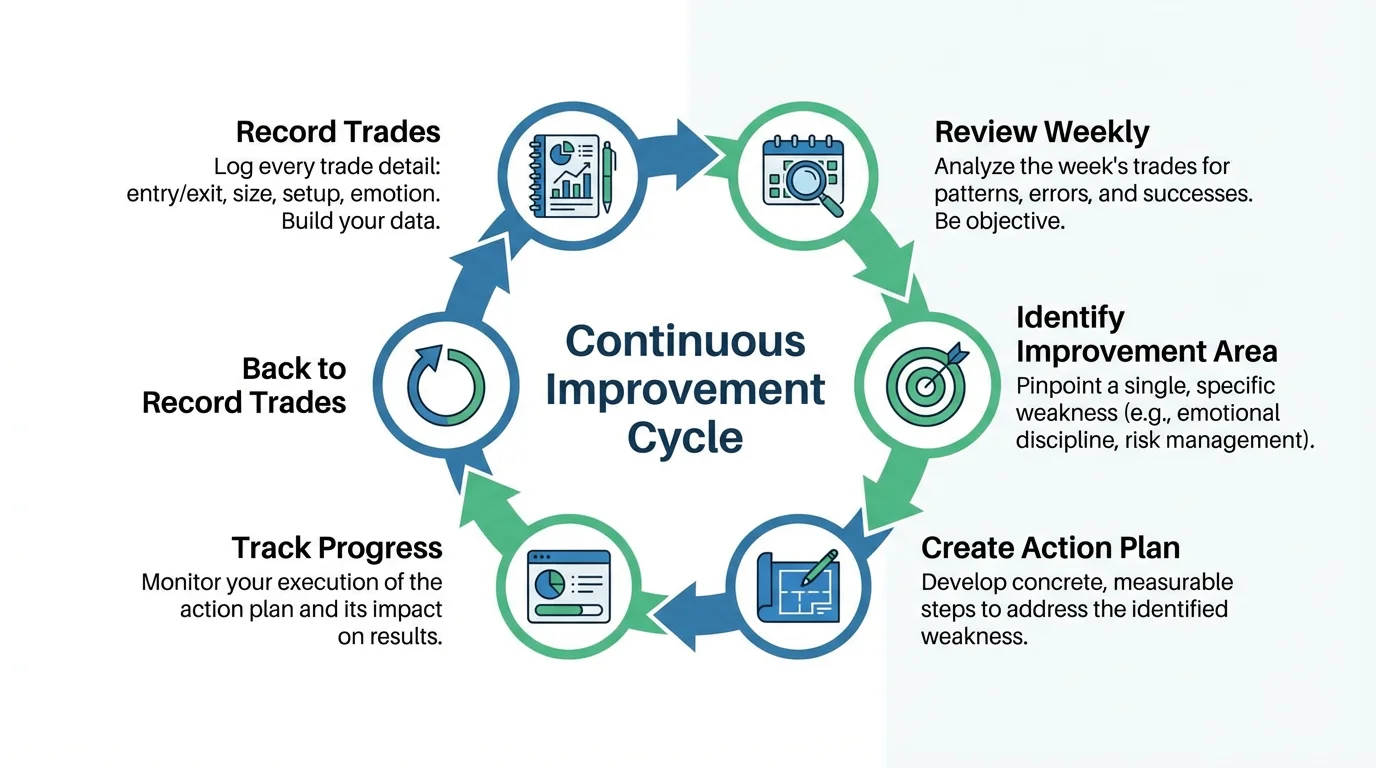
Keeping a trading journal is only the first step. The real power of a journal comes from the process of reviewing and analyzing your trades. Here is a simple process you can follow:
Step 1: Record Your Trades Immediately After They Close
After each trading day, take the time to record all of your trades in your journal. Be as detailed and as honest as possible. Don’t wait until the end of the week to record your trades; record them immediately while they’re fresh in your mind. This ensures that your entries are accurate and that you capture all the important details.
The act of recording your trades forces you to be more deliberate and thoughtful about your trading. It also creates a written record that you can refer back to later.
Step 2: Review Your Trades Weekly
At the end of each week, set aside some time to review all of your trades from the past week. Look for patterns in your behavior. Are you consistently making the same mistakes? Are you more profitable in certain market conditions? Are there specific times of day when you trade better?
This weekly review is crucial. It allows you to identify patterns that might not be obvious from looking at individual trades. You might notice that you always overtrade on Mondays, or that you always hold your winners too long when you’re feeling confident.
Step 3: Identify One Key Area for Improvement
Based on your weekly review, identify one key area where you want to improve in the coming week. This could be anything from sticking to your stop-loss orders to avoiding impulsive trades. The key is to focus on one area at a time. Trying to improve everything at once is overwhelming and ineffective.
Write down your improvement goal and keep it visible on your trading desk. This serves as a reminder and helps to keep you focused.
Step 4: Create an Action Plan
Once you have identified your area for improvement, create a specific action plan for how you will address it. For example, if you are struggling with impulsive trading, your action plan might be to take a 5-minute break before entering any trade. If you are struggling with holding losers too long, your action plan might be to use automated stop-loss orders.
Your action plan should be specific, measurable, and achievable. Instead of saying “I will be more disciplined,” say “I will use automated stop-loss orders on every trade.”
Step 5: Track Your Progress
As you implement your action plan, track your progress in your journal. Are you seeing an improvement in your trading performance? Are you feeling more confident and in control? Keep notes on what’s working and what’s not.
By following this process of continuous feedback and improvement, you can use your trading journal to literally rewire your brain. You can create new neural pathways that will make disciplined and profitable trading more automatic and effortless.
| Journaling Step | Action | Outcome | Frequency |
|---|---|---|---|
| 1. Record | Document all trade details and psychological states daily. | Creates a rich dataset for analysis. | After each trade closes |
| 2. Review | Analyze trades weekly to identify recurring patterns. | Uncovers hidden strengths, weaknesses, and biases. | Once per week |
| 3. Identify | Pinpoint one specific area for improvement for the next week. | Focuses your efforts on a single, manageable goal. | Once per week |
| 4. Plan | Create a concrete action plan to address the identified issue. | Provides a clear path for behavioral change. | Once per week |
| 5. Track | Monitor your progress and adjust your plan as needed. | Reinforces new habits and accelerates your learning curve. | Ongoing |
Real-World Example: From Struggling Trader to Profitable Trader
Consider the case of a trader named James. James had been trading Forex for two years, but he was consistently unprofitable. He had a decent trading strategy, but he couldn’t seem to execute it properly. He would take trades that didn’t meet his criteria, he would exit winning trades too early, and he would hold losing trades too long.
James decided to start keeping a detailed trading journal. For the first week, he just recorded his trades without analyzing them. But as he reviewed his journal at the end of the week, he started to see patterns. He noticed that he was most likely to break his rules when he was feeling anxious or bored. He also noticed that he was more profitable when he traded during the London session than during other times of the day.
Based on these observations, James created an action plan. He decided to only trade during the London session, and he decided to take a 5-minute break whenever he felt anxious or bored. He also decided to use automated stop-loss orders to prevent himself from holding losers too long.
Over the next month, James continued to keep his journal and to review it weekly. He made adjustments to his action plan as needed. By the end of the month, his trading performance had improved significantly. He was more profitable, he was breaking his rules less often, and he was feeling more confident and in control.
More importantly, James had rewired his brain. The new habits he had developed through his journaling process had become more automatic. He no longer had to consciously remind himself to follow his trading plan; it had become his default behavior.
Best Practices for Maintaining Your Trading Journal
To get the most out of your trading journal, follow these best practices:
Be Honest and Objective
Write down the truth about your trades, even if it’s not flattering. If you made a stupid mistake, write it down. If you got lucky, write it down. The more honest you are in your journal, the more you can learn from it.
Be Consistent
Record your trades every single day, without exception. Consistency is key to building the habit and to getting the full benefit of journaling.
Be Specific
Don’t just write “I took a bad trade.” Write down exactly what made it a bad trade. What was your reasoning? What did you do wrong? The more specific you are, the more you can learn.
Review Regularly
Don’t just write in your journal and forget about it. Review your journal regularly, at least weekly. This is where the real learning happens.
Adjust Your Approach
As you learn more about yourself and your trading, adjust your journal template and your review process. Your journal should evolve as you evolve as a trader.
Conclusion
A trading journal is not just a record-keeping tool; it is a powerful instrument for personal transformation. It is the key to unlocking your full potential as a trader. By diligently recording your trades, honestly assessing your performance, and consciously working to improve your weaknesses, you can use your forex trading journal template to rewire your decision-making, cultivate discipline, and build the unshakable confidence that is the hallmark of every successful trader. The journey to trading mastery begins with a single entry in your journal. Start yours today, and commit to the process of continuous improvement. Your future self will thank you for it.